
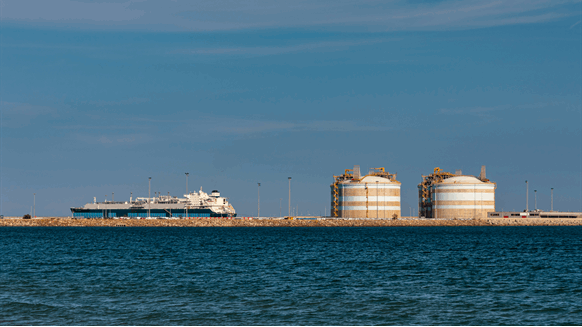
South Africa’s Transnet National Ports Authority (TNPA) has executed a 25-year terminal agreement with Ukwanda LNG for a regasification project at the Port of Ngqura.
The project involves the installation of a temporary floating unit at the deepwater port and permanent onshore infrastructure to deliver gas to customers including the industrial sector, data centers and independent power producers, TNPA said in an online statement.
The regasification terminal will thereby enable the production of about 3,500 megawatts of electricity in the Coega Special Economic Zone, TNPA said.
With an estimated investment of ZAR 22 billion ($1.36 billion), the project “will see the construction of the ZAR 2 billion dedicated LNG berth by TNPA happening simultaneously with the development of the onshore facility, targeting full operationalization by 2035 to achieve security of supply for energy”, TNPA said.
The project would position the Eastern Cape “as a strategic energy hub while advancing South Africa’s energy security and industrial growth”, TNPA said.
Transnet group chief executive Michelle Phillips said, “This milestone represents a profound shift in how South Africa utilizes its commercial seaports to support national energy security”.
The partner, Ukwanda LNG, is a joint venture between Tamasa Energy Group and the Strategic Fuel Fund.
The government plans to install 6 gigawatts (GW) of combined-cycle gas turbine (CCGT) generation capacity by the end of the decade as part of the country’s efforts to wean itself off coal.
“The requirement for gas CCGT in the South African power system by 2030 is critical in lieu of the impending decommissioning of 8 GW of baseload coal-fired plants”, the Energy Ministry said in its Integrated Resource Plan 2025. “Due to new technology options lead times, there are limited credible options of a dispatchable nature that can fill the gap by 2030”.
However, “as gas is currently not indigenous to South Africa, a case for gas-to-power, particularly to enable integration into the power system by 2030, requires consideration for appropriate infrastructure development to enable the delivery of gas molecules in the longer term”, the ministry said.
Nonetheless it warned, “Securing liquefied natural gas and associated infrastructure in South Africa by 2030 remains a risk and may require policy adjustment to ensure timelines are met”.
The ministry added that “there is a need to consider converting the existing diesel-powered peaking plants to natural gas as primary energy”.
While renewable energy technologies “remain consistently favorable in all cases”, the ministry said “their variability requires the support of other technologies of a dispatchable nature to ensure a continuous and reliable supply of electricity”.
“Further, the technologies lack sufficient grid support and ancillary services, creating a challenge for power system operability with high penetration of these resources”, the ministry said.
Beyond 2030, the ministry sees the case for a delayed shutdown of coal plants, which would keep 15 GW of capacity between 2034 and 2042, as “requirements for new generation and transmission infrastructure may be onerous”.